Published at Renewable Energy World:
Prior to launching a nationwide Feed-in tariff (FIT) program in 2019, Japan implemented various solar incentive schemes, including a Surplus PV generation Purchase program from residential solar photovoltaic (PV) owners.
The Japanese government launched this program in fall 2009 and required the nation’s large investor-owned utilities (IOUs) to purchase excess electricity from PV systems (below 10 kW) owned by homeowners at a fixed, premium rate of 48 yen/kWh (~54 US cents/kWh) for the duration of 10 years.
2019 marks the end for those who enrolled in this program 10 years ago.
According to the nation’s Ministry of Economy, Trade, and Industry (METI), by the end of this year, the IOUs will stop purchasing excess electricity from 2 GW worth of PV systems owned by 530,000 homes in Japan.
And that number will increase to over 1.65 million homes (or 6.7 GW of PV systems) by 2023... Read More Here
Showing posts with label FIT. Show all posts
Showing posts with label FIT. Show all posts
November 19, 2019
December 20, 2017
米国の州で始まった太陽光・新買取制度の「革新性」 大規模案件の入札結果に連動、農地などに「特別加算」も
Published at Nikkei Technology Online ---
マサチューセッツ州はこれまで、RPS(Renewable Portfolio Standard:再生可能エネルギー・ポートフォリオ基準)法に基づき、太陽光発電・環境価値(Solar Renewable Energy Credit:SREC)買取制度を導入し、既に連系出力1.6GWが導入済みだ。
州の目標に「太陽光1.6GW」
米国マサチューセッツ州は2017年11月、太陽光発電システムの新しい買取制度をスタートさせた。メガソーラー(大規模太陽光発電所)の入札での落札価格をもとに、小・中規模の太陽光発電の買取価格が設定される「ハイブリッド」型にしたのが特徴だ。
同買取制度は、マサチューセッツ州が定めた再生可能エネルギーの導入目標である「Solar Massachusetts Renewable Target(SMART)」の頭文字をとって、「スマート・ソーラープログラム」と名付けられた。同州は、今後数年間で連系出力合計1.6GWの太陽光発電システムを導入する目標を掲げている。プログラムの対象となる太陽光発電システムのサイズは25kW以下の小規模案件から5MWのメガソーラーまで幅広く設定している(図1)。
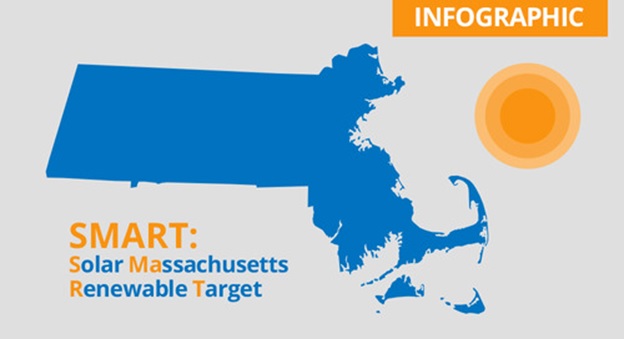 |
| 図1●1.6GWの太陽光の導入目標を掲げた (出所:Massachusetts Department of Energy Resources) |
マサチューセッツ州はこれまで、RPS(Renewable Portfolio Standard:再生可能エネルギー・ポートフォリオ基準)法に基づき、太陽光発電・環境価値(Solar Renewable Energy Credit:SREC)買取制度を導入し、既に連系出力1.6GWが導入済みだ。
しかし、SREC買取制度は株式市場のように価格変動が大きいため、太陽光発電事業者にとっては将来の収入予測が難しく、ファイナンスに課題があった。そのため今回は買取価格を長期間固定し、安定的かつ継続的な収入を確保することでビジネスリスクを下げ、資金調達を容易にする狙いがある。
200MWごとに4%ずつ低下
スマート・ソーラープログラムの運用では、1.6GWを200MWずつの8つの「ブロック」に分け、ブロックが埋まるごとに買取価格が4%ずつ下がる。これは「逓減ブロック」と呼ばれるモデルで、需要の拡大に応じて価格が低下する仕組みである。... Read More Here
August 26, 2016
Japan’s First Floating Solar System with Microinverters Installed on an Irrigation Reservoir
Published at RenewableEnergyWorld.com --- On a farming reservoir in Fukuoka City, Fukuoka prefecture, 1,200 photovoltaic (PV) modules cover the water surface to generate electricity and additional revenues for the city. Many floating solar systems have been developed in Japan, but this 300-kW system, which became operational this July, is a bit different. This is the nation’s first floating solar system equipped with micro inverters.
Due to the steep topography, rivers are short in Japan; water flows out rather quickly to the sea. For this reason, a great number of reservoirs have been created for farming irrigation, specifically for rice paddies. It is estimated that there are over 190,000 reservoirs throughout Japan. Fukuoka city is not an exception. The city located on the island of Kyushu, the most southwesterly of Japan’s four main islands, has over 300 irrigation reservoirs.
Local governments maintain and operate these reservoirs, and they have been finding a way to reduce the cost of managing reservoirs. Floating solar systems can provide a viable solution: local governments can generate extra revenue by leasing the surface of reservoirs.
According to a city official at the Fukuoka City’s Department of Agriculture, Forestry, and Fisheries, last July the city issued a proposal for reuse options and a lease for a city-owned reservoir as part of a plan for effective utilization of the city’s assets....Read More Here
Due to the steep topography, rivers are short in Japan; water flows out rather quickly to the sea. For this reason, a great number of reservoirs have been created for farming irrigation, specifically for rice paddies. It is estimated that there are over 190,000 reservoirs throughout Japan. Fukuoka city is not an exception. The city located on the island of Kyushu, the most southwesterly of Japan’s four main islands, has over 300 irrigation reservoirs.
Local governments maintain and operate these reservoirs, and they have been finding a way to reduce the cost of managing reservoirs. Floating solar systems can provide a viable solution: local governments can generate extra revenue by leasing the surface of reservoirs.
According to a city official at the Fukuoka City’s Department of Agriculture, Forestry, and Fisheries, last July the city issued a proposal for reuse options and a lease for a city-owned reservoir as part of a plan for effective utilization of the city’s assets....Read More Here
 |
| Japan’s first floating solar system with microinverters on Irrigation Reservoir Credit: NEP Microinverter, Inc. |
March 11, 2016
Japan at the Electricity Crossroads: Nuclear Power to Lower Electricity Bills or Solar Power to Create Resiliency?
Published at Renewable Energy World --- March 11, 2016 marks the five-year anniversary of the 2011 Tohoku earthquake and tsunami, which caused catastrophic meltdowns at three reactors in the Fukushima Daiichi Nuclear Power Plant complex in Fukushima Prefecture. This devastating event resulted in a major change to the nation’s electricity supply market. It led to the introduction of the national feed-in tariff (FIT) program in July 2012 and historical liberalization of the retail electricity market, which will commence in April.
In regards to the upcoming deregulated electricity market, 210 companies have currently registered as retail electricity providers to compete against the 10 incumbent utilities, which had enjoyed the regional monopolies for several decades.
As fierce competition is anticipated, the incumbent utilities have restarted or plan to restart nuclear reactors to be cost-competitive. In fact, last year Kyushu Power Electric Company, located in the Kyushu region, restarted two nuclear reactors in Kagoshima Prefecture and, last month, Kansai Electric Power Corporation, the nation’s second largest electric provider, has restarted two reactors at Takahama Nuclear Plant in Fukui Prefecture to provide “lower rates” than those offered by new competitors.
Turning Nuclear Contaminated Town into Denuclearized Town with Renewable Energy
“I am very furious,” commented Katsunobu Sakurai, the mayor of Minamisoma City, at a press conference for the Foreign Correspondents’ Club of Japan. He is angry and frustrated that the utilities have restarted nuclear reactors since Minamisoma City, located less than 20 kilometers (12.4 miles) northwest of the Fukushima Daiichi Nuclear Power Plant, has not yet fully recovered. The city was heavily affected by the disasters which displaced 14,000 residents after the accident. It has been five years since the nuclear meltdown, however, residents of certain areas of the city have not been allowed to return since the national government has not yet lifted evacuation orders....Read More Here
 |
| PV plus Storage Installed at a School, Credit: Minamisyna City |
In regards to the upcoming deregulated electricity market, 210 companies have currently registered as retail electricity providers to compete against the 10 incumbent utilities, which had enjoyed the regional monopolies for several decades.
As fierce competition is anticipated, the incumbent utilities have restarted or plan to restart nuclear reactors to be cost-competitive. In fact, last year Kyushu Power Electric Company, located in the Kyushu region, restarted two nuclear reactors in Kagoshima Prefecture and, last month, Kansai Electric Power Corporation, the nation’s second largest electric provider, has restarted two reactors at Takahama Nuclear Plant in Fukui Prefecture to provide “lower rates” than those offered by new competitors.
Turning Nuclear Contaminated Town into Denuclearized Town with Renewable Energy
“I am very furious,” commented Katsunobu Sakurai, the mayor of Minamisoma City, at a press conference for the Foreign Correspondents’ Club of Japan. He is angry and frustrated that the utilities have restarted nuclear reactors since Minamisoma City, located less than 20 kilometers (12.4 miles) northwest of the Fukushima Daiichi Nuclear Power Plant, has not yet fully recovered. The city was heavily affected by the disasters which displaced 14,000 residents after the accident. It has been five years since the nuclear meltdown, however, residents of certain areas of the city have not been allowed to return since the national government has not yet lifted evacuation orders....Read More Here
January 26, 2016
The 2016 Global PV Outlook: US, Asian Markets Strengthened by Policies to Reduce CO2
Published at RenewableEnergyWorld.com --- Global solar installations will reach 64.7 GW in 2016 according to Mercom Capital Group, a clean energy communications and research firm based in Texas. “The top 3 countries will be China, U.S., and Japan and they will account for about two thirds of the global market,” said Raj Prabhu, CEO and co-founder of Mercom.
Although China is expected to continue leading the global PV market, the U.S. will show the most robust growth in 2016, due to the anticipation of the federal Investment Tax Credit (ITC) expiration, which developers and EPC had already factored into their business plans for 2016, prior to the five-year extension received at the end of 2015.
In 2016, the U.S. is set to overtake Japan as the second largest solar market, exceeding the much-anticipated 10-GW mark. Another notable shift will see India move up to the No. 4 position, pushing down the former European leaders, U.K. and Germany.
China: Remains No. 1 Market with Some Trouble Ahead
China is expected to install approximately 19.5 GW in 2016, a rise of 14.7 percent over 2015, Mercom predicts. “The country is strongly committed [to solar] because of the pollution problems. Air pollution continues to drive China’s environmental policies, of which clean power generation is a big part,” said Prabhu.
Officials from China’s National Energy Administration (NEA) are considering raising the 2020 target from 100 GW to 150 GW, which will bring about 21 GW of annual installation between 2016 through 2020. China also has pledged to reach an ‘emissions peak’ around 2030 with non-fossil fuels making up 20 percent of the nation’s energy generation mix. “All of these factors have made renewable forms of energy a vital component of the Chinese economy for years to come,” stated Prabhu.
The rapid PV deployment, however, has caused growing grid congestion problems. In addition, the nation’s economic conditions also deteriorated in 2015. “Production curtailment and subsidies continue to be the biggest challenges facing the Chinese solar industry. Subsidy payment delays up to 18 months have been reported by solar project developers causing cash flow problems. Some companies have reported selling out projects and stopping further project development activities as they are unable to sustain without timely subsidy payments,” said Prabhu....Read More Here
Although China is expected to continue leading the global PV market, the U.S. will show the most robust growth in 2016, due to the anticipation of the federal Investment Tax Credit (ITC) expiration, which developers and EPC had already factored into their business plans for 2016, prior to the five-year extension received at the end of 2015.
In 2016, the U.S. is set to overtake Japan as the second largest solar market, exceeding the much-anticipated 10-GW mark. Another notable shift will see India move up to the No. 4 position, pushing down the former European leaders, U.K. and Germany.
China: Remains No. 1 Market with Some Trouble Ahead
China is expected to install approximately 19.5 GW in 2016, a rise of 14.7 percent over 2015, Mercom predicts. “The country is strongly committed [to solar] because of the pollution problems. Air pollution continues to drive China’s environmental policies, of which clean power generation is a big part,” said Prabhu.
Officials from China’s National Energy Administration (NEA) are considering raising the 2020 target from 100 GW to 150 GW, which will bring about 21 GW of annual installation between 2016 through 2020. China also has pledged to reach an ‘emissions peak’ around 2030 with non-fossil fuels making up 20 percent of the nation’s energy generation mix. “All of these factors have made renewable forms of energy a vital component of the Chinese economy for years to come,” stated Prabhu.
The rapid PV deployment, however, has caused growing grid congestion problems. In addition, the nation’s economic conditions also deteriorated in 2015. “Production curtailment and subsidies continue to be the biggest challenges facing the Chinese solar industry. Subsidy payment delays up to 18 months have been reported by solar project developers causing cash flow problems. Some companies have reported selling out projects and stopping further project development activities as they are unable to sustain without timely subsidy payments,” said Prabhu....Read More Here
December 14, 2015
Popular Hot Springs in Japan Co-exist with Binary Geothermal Power Plants
Published at Renewable Energy World --- Japanese people love Onsen, or hot springs, to relax and feel rejuvenated in naturally heated, spring water, which is rich in minerals. Hot springs are located in mountains, next to rivers, near oceans, and basically everywhere due to the abundance of active volcanoes present in Japan. In fact, there are 27,405 identified hot spring wells and over 21,000 combined hot spring spas and inns, according to 2014 data published by the nation’s Ministry of Environment.
Over 126 million people visit Onsens annually, spending considerable amount of money at spas, hotels, restaurants, and shops at hot springs. Because of the significant economic activities related to tourism, local communities didn’t think that Onsen business and geothermal power plants could co-exist.
They were concerned that deployment of geothermal power plants would change the quality and compositions of spring water, which contains a lot of organic matter that is known to provide health and beauty benefits. Most importantly, the community feared that geothermal power plants would dry up their precious spring water wells.
Their concerns were eliminated when binary geothermal power plants were introduced.
Nation’s First Binary System Installed at an Evacuation Site
Yumura Onsen in Shinonsen town, Hyogo prefecture, installed two 20 kW (a total of 40 kW) binary geothermal power plants at Yakushiyu, a day spa, which also is a state designated evacuation site where people in the community can assemble in the case of emergencies or disasters.
Binary geothermal power plants, or “Onsen” Binary plants, use chemical fluids known as a second liquid (e.g., Isobutene and n-Pentane) that boils at a lower temperature than water. Hot spring water passes through a heat exchanger and heats up the second liquid in a closed loop. Heat from the geothermal water causes the secondary fluid to flash to vapor, which then drives the turbines, and subsequently the generators. The vapor is condensed back to liquid and begins the cycle again. Because this is a closed-loop system, virtually nothing is emitted to the atmosphere....Read More Here
Over 126 million people visit Onsens annually, spending considerable amount of money at spas, hotels, restaurants, and shops at hot springs. Because of the significant economic activities related to tourism, local communities didn’t think that Onsen business and geothermal power plants could co-exist.
They were concerned that deployment of geothermal power plants would change the quality and compositions of spring water, which contains a lot of organic matter that is known to provide health and beauty benefits. Most importantly, the community feared that geothermal power plants would dry up their precious spring water wells.
Their concerns were eliminated when binary geothermal power plants were introduced.
Nation’s First Binary System Installed at an Evacuation Site
Yumura Onsen in Shinonsen town, Hyogo prefecture, installed two 20 kW (a total of 40 kW) binary geothermal power plants at Yakushiyu, a day spa, which also is a state designated evacuation site where people in the community can assemble in the case of emergencies or disasters.
 |
| “Onsen” Binary Geothermal Systems (2 x 20 kW), Credit: The Town of Shinonsen |
Binary geothermal power plants, or “Onsen” Binary plants, use chemical fluids known as a second liquid (e.g., Isobutene and n-Pentane) that boils at a lower temperature than water. Hot spring water passes through a heat exchanger and heats up the second liquid in a closed loop. Heat from the geothermal water causes the secondary fluid to flash to vapor, which then drives the turbines, and subsequently the generators. The vapor is condensed back to liquid and begins the cycle again. Because this is a closed-loop system, virtually nothing is emitted to the atmosphere....Read More Here
November 24, 2015
Japan Passes FIT Peak: Now What for 87 GW Renewable Queue, 2030 Energy Mix?
Published at RenewableEnergyWorld.com --- Between July 2013 and July 2015, the Japanese feed-in tariff (FIT) program has supported the installation of over 22 GW worth of renewable energy nationwide, according to the latest data released by the Ministry of Economy, Industry and Trade (METI). That means, in only three years, the nation doubled its renewable energy capacity. Those renewable energy projects have cumulatively generated 66,854 GWh of renewable electricity, roughly equivalent to the annual electricity consumption of the state of Minnesota, ranked 19th in the U.S. for clean power generation.
The FIT program heavily skewed toward solar
Although the program supports five renewable technologies: solar photovoltaic (PV), wind, hydro (below 30 MW), geothermal and biomass, PV accounts for 96 percent of the 22 GW of installed capacity in the last 37 months.
The FIT program aided Japan in its ascent towards becoming one of the world’s biggest PV markets in 2013 and 2014. According to METI’s data, Japan installed 8.51 GW of PV under the FIT program. In the first seven months of this year, Japan has already installed a little over 6 GW. If Japan manages to install 1 GW of PV every month from August to December of this year, Japan will hit, as many PV industry analysts have predicted, 10 GW and solidify its position at the top of the list again this year....Read More Here
 |
| Source: Japan METI |
Although the program supports five renewable technologies: solar photovoltaic (PV), wind, hydro (below 30 MW), geothermal and biomass, PV accounts for 96 percent of the 22 GW of installed capacity in the last 37 months.
 |
| Source: Japan METI |
The FIT program aided Japan in its ascent towards becoming one of the world’s biggest PV markets in 2013 and 2014. According to METI’s data, Japan installed 8.51 GW of PV under the FIT program. In the first seven months of this year, Japan has already installed a little over 6 GW. If Japan manages to install 1 GW of PV every month from August to December of this year, Japan will hit, as many PV industry analysts have predicted, 10 GW and solidify its position at the top of the list again this year....Read More Here
November 4, 2015
再エネ電力を電力会社より安く販売できる「CCA制度」(後半) 地産地消を促すFITも取り入れる
Published at Nikkei Technology Online --- 米国では、地方自治体などが住民、ビジネス、さらに公共施設用の電力需要をまとめて購入できるコミュニティ・チョイス・アグリゲーション(Community Choice Aggregation:CCA)と呼ばれる法律がある。この法律により、地方自治体は自ら発電事業者から電力を調達し、地域独占電力会社の送配電網を使い、よりエコで手ごろな電気料金「チョイス」を直接、コミュニティーに提供できるようになった。
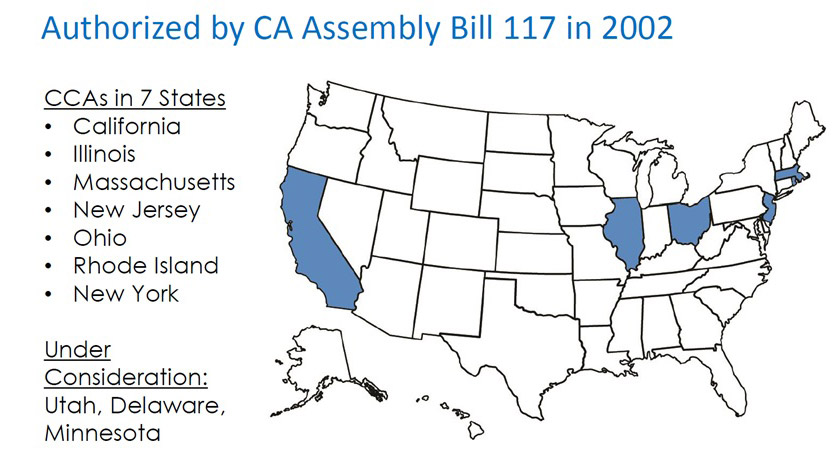
2002年のカリフォルニア州での導入を皮切りに、現在全米7州でCCAが実地されている(図1)。1300の地方自治体が、米国電力消費者の約5%に当たる顧客にCCAプログラムを通じて電力を供給している。
カリフォルニア州では現在、3つの自治体がCCAプログラムを運営している。同州北部に位置するマリーン郡は、最初にCCA制度を導入した地方自治体である。CCAプログラムはマリーンクリーンエネルギー(Marin Clean Energy:MCE)というNPO法人が運営しており、現在約17万5000軒の顧客をかかえる。地域の電力需要者は従来の大手電力会社から乗り換えることにより、今年は1060万ドル(約12.6億円)の電気料金削減と、6万t以上の温室効果ガス削減が見込まれている。.. Read More Here
2002年のカリフォルニア州での導入を皮切りに、現在全米7州でCCAが実地されている(図1)。1300の地方自治体が、米国電力消費者の約5%に当たる顧客にCCAプログラムを通じて電力を供給している。
 |
| Credit: Lean Energy U.S. |
カリフォルニア州では現在、3つの自治体がCCAプログラムを運営している。同州北部に位置するマリーン郡は、最初にCCA制度を導入した地方自治体である。CCAプログラムはマリーンクリーンエネルギー(Marin Clean Energy:MCE)というNPO法人が運営しており、現在約17万5000軒の顧客をかかえる。地域の電力需要者は従来の大手電力会社から乗り換えることにより、今年は1060万ドル(約12.6億円)の電気料金削減と、6万t以上の温室効果ガス削減が見込まれている。.. Read More Here
October 21, 2015
再エネ電力を電力会社より安く販売できる「CCA制度」(前半) 地方自治体が太陽光や風力をまとめ買いして消費者に提供
Published at Nikkei Technology --- 米カリフォルニア州では、2000~2001年に発生した電力危機が原因で小売全面自由化が保留になってしまった。民間電力会社の地域独占が継続され、家庭用電力消費者は電力購入の「チョイス(選択)」の機会を失った。
にもかかわらず、同州北部マリーン郡とその周辺の消費者は、電力の購入先を大手電力会社から地方自治体に乗り換え、環境に優しい再生可能エネルギーを選ぶことができる。乗り換えにより、今年は1060万ドル(約12.6億円)の電気料金と、6万t以上の温室効果ガス削減が見込まれている。
こうした「乗り換え」を可能にしているのが、コミュニティー・チョイス・アグリゲーション(Community Choice Aggregation: CCA)と呼ばれる法律だ。同法は、地方自治体などが住民、ビジネス、さらに公共施設用の電力需要をまとめて購入できることを規定したもので、2002年に成立した。この法律により、地方自治体は、自ら電力を発電、または発電事業者から電力を調達し、コミュニティーに「チョイス」を提供できるようになった。
顧客は17万5000軒を超える
カリフォルニア州北部に位置するマリーン郡は、州で最初にCCA制度を導入した地方自治体である。マリーン・クリーン・エネルギー(Marin Clean Energy:MCE)というNPO法人が2008年に設立され、2010年からコミュニティーの電力需要をまとめ、電力を調達し始めた。
「マリーン郡では、地球温暖化防止対策として建物部門からのCO2排出削減に取り組んでいます。電力消費によるCO2 排出量の抑制策として、再生可能エネルギーの導入を拡大できるCCAに着目しました」と、MCEでCEO(最高経営責任者)を務めるDawn Weisz氏は同機関の創設までの経緯について語った。...Read More Here
にもかかわらず、同州北部マリーン郡とその周辺の消費者は、電力の購入先を大手電力会社から地方自治体に乗り換え、環境に優しい再生可能エネルギーを選ぶことができる。乗り換えにより、今年は1060万ドル(約12.6億円)の電気料金と、6万t以上の温室効果ガス削減が見込まれている。
こうした「乗り換え」を可能にしているのが、コミュニティー・チョイス・アグリゲーション(Community Choice Aggregation: CCA)と呼ばれる法律だ。同法は、地方自治体などが住民、ビジネス、さらに公共施設用の電力需要をまとめて購入できることを規定したもので、2002年に成立した。この法律により、地方自治体は、自ら電力を発電、または発電事業者から電力を調達し、コミュニティーに「チョイス」を提供できるようになった。
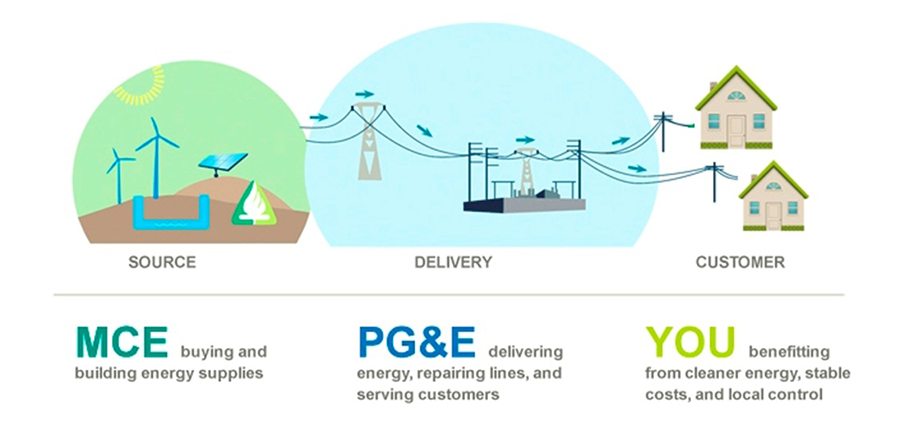 |
| How CCA Works; Credit: MCE |
顧客は17万5000軒を超える
カリフォルニア州北部に位置するマリーン郡は、州で最初にCCA制度を導入した地方自治体である。マリーン・クリーン・エネルギー(Marin Clean Energy:MCE)というNPO法人が2008年に設立され、2010年からコミュニティーの電力需要をまとめ、電力を調達し始めた。
「マリーン郡では、地球温暖化防止対策として建物部門からのCO2排出削減に取り組んでいます。電力消費によるCO2 排出量の抑制策として、再生可能エネルギーの導入を拡大できるCCAに着目しました」と、MCEでCEO(最高経営責任者)を務めるDawn Weisz氏は同機関の創設までの経緯について語った。...Read More Here
July 11, 2015
Japan's Long-term Energy Plan Shoots for Ultimate Balance in Economics, Environment and Safety
Published at Renewable Energy World --- What is 3E + S? It is neither a mathematics problem nor chemical equation. It is Japan’s latest long-term energy plan, which was released by Japan's Ministry of Economy, Trade and Industry (METI) on June 1stf for review. The draft plan aims to establish an optimum energy mix by the year 2030.
The three Es stand for the first letters in Energy Security, Economic Efficiency and Environment and the letter S stands for Safety. Safety is crucial to the energy plan in the wake of the world’s worst nuclear disaster since Chernobyl when the devastating tsunami and earthquake hit northeast Japan in 2011. Since the disasters, Japan’s electricity generation mix has drastically changed.
The fear of nuclear power plants led to the shutting down of 54 of the nation’s nuclear reactors, which used to provide about 30 percent of the nation electricity. To make up for the loss of electricity supplied by nuclear means, Japan turned its heads toward coal and Liquefied Natural Gas (LNG). The nation’s sharp increase in fossil fuel demand caused the price of LNG, linked to crude oil import price, to soar.

The transition from nuclear to fossil fuels caused the nation’s energy self-sufficiency percentage to plummet to a mere 6 percent and Japan’s greenhouse gasses to hit an alarming record high in 2013. The increase cost of fossil fuel imports and the nationwide feed-in tariff (FIT) program has also increased electricity prices by 30 percent for industry users and 20 percent for residential consumers.
New Plan to Reverse the Effect of Fossil Fuels
The 3E + S plan aims to reverse the effects brought by the increased consumption of fossil fuels. Japan specifically wants to improve its self-sufficiency to 25 percent above the pre-disaster level. It also hopes to control and reduce electricity cost for the nation’s industry to gain back a competitive advantage while reducing greenhouse gas emissions to the same level as the Western nations.Read More Here
The three Es stand for the first letters in Energy Security, Economic Efficiency and Environment and the letter S stands for Safety. Safety is crucial to the energy plan in the wake of the world’s worst nuclear disaster since Chernobyl when the devastating tsunami and earthquake hit northeast Japan in 2011. Since the disasters, Japan’s electricity generation mix has drastically changed.
The fear of nuclear power plants led to the shutting down of 54 of the nation’s nuclear reactors, which used to provide about 30 percent of the nation electricity. To make up for the loss of electricity supplied by nuclear means, Japan turned its heads toward coal and Liquefied Natural Gas (LNG). The nation’s sharp increase in fossil fuel demand caused the price of LNG, linked to crude oil import price, to soar.
The transition from nuclear to fossil fuels caused the nation’s energy self-sufficiency percentage to plummet to a mere 6 percent and Japan’s greenhouse gasses to hit an alarming record high in 2013. The increase cost of fossil fuel imports and the nationwide feed-in tariff (FIT) program has also increased electricity prices by 30 percent for industry users and 20 percent for residential consumers.
New Plan to Reverse the Effect of Fossil Fuels
The 3E + S plan aims to reverse the effects brought by the increased consumption of fossil fuels. Japan specifically wants to improve its self-sufficiency to 25 percent above the pre-disaster level. It also hopes to control and reduce electricity cost for the nation’s industry to gain back a competitive advantage while reducing greenhouse gas emissions to the same level as the Western nations.Read More Here
May 21, 2015
Panasonic Ramps Up Japanese Solar Manufacturing to Meet Domestic Rooftop Demand
Published at Renewable Energy World --- Panasonic Corp, a Japanese electronics company, announced that it will expand its domestic solar cell and module production to meet the rooftop solar demand in Japan. The company will invest a total of 9.5 billion yen (US$78 million) in a cell production plant in Shimane Prefecture and a module plant in Shiga Prefecture.
The company’s current HIT production capacity is 900 MW per year, of which 300 MW is produced in Malaysia and 600 MW in Japan. The new investment will boost the domestic production capacity 150 MW to total 750 MW by March 2016, making its total annual production capacity more than 1 GW.

Panasonic’s solar cells, known as HIT, are hetero-junction cells composed of monocrystalline and amorphous silicon. Panasonic reached a conversion efficiency of 25.6 percent last year at the research level, and 22.5 percent at the mass production level. Since high-efficiency cells enable more power per square foot than conventional solar cells, they provide a greater advantage to the majority of Japanese homes and offices, which have very limited roof-space.
The company will allocate the boosted domestic production capacity solely to the domestic market, specifically residential and rooftop systems below 500 kW while allocating modules produced in Malaysia to overseas markets.
Furthermore, as the domestic production ramps up, the company will phase out outsourced modules. The company has outsourced multicrystalline solar modules under an original equipment manufacturer (OEM) contract from Europe in order to meet demand for a large quantity of relatively inexpensive modules used for Mega Solar projects. In the fiscal year 2014, ending in March 2015, the outsourced solar modules represented approximately 18 percent of the company’s entire solar module sales, but the increased domestic production capacity will eventually replace all the outsourced modules... Read More Here
The company’s current HIT production capacity is 900 MW per year, of which 300 MW is produced in Malaysia and 600 MW in Japan. The new investment will boost the domestic production capacity 150 MW to total 750 MW by March 2016, making its total annual production capacity more than 1 GW.
Panasonic’s solar cells, known as HIT, are hetero-junction cells composed of monocrystalline and amorphous silicon. Panasonic reached a conversion efficiency of 25.6 percent last year at the research level, and 22.5 percent at the mass production level. Since high-efficiency cells enable more power per square foot than conventional solar cells, they provide a greater advantage to the majority of Japanese homes and offices, which have very limited roof-space.
The company will allocate the boosted domestic production capacity solely to the domestic market, specifically residential and rooftop systems below 500 kW while allocating modules produced in Malaysia to overseas markets.
Furthermore, as the domestic production ramps up, the company will phase out outsourced modules. The company has outsourced multicrystalline solar modules under an original equipment manufacturer (OEM) contract from Europe in order to meet demand for a large quantity of relatively inexpensive modules used for Mega Solar projects. In the fiscal year 2014, ending in March 2015, the outsourced solar modules represented approximately 18 percent of the company’s entire solar module sales, but the increased domestic production capacity will eventually replace all the outsourced modules... Read More Here
April 20, 2015
Japan Solar Boom Spurred by Low-Interest Loans from Local Banks, Credit Unions, Utilities
Published at Renewable Energy World --- San Diego, Calif. — The U.S. residential solar photovoltaic (PV) market is on the rise. According to SEIA/GTM Research, in 2014 the residential market surpassed the non-residential market for the first time. "The past three years have now seen the residential market grow by at least 50 percent on an annual basis, buoyed by major strides to lower soft costs, in tandem with increased penetration of third party financing solutions,” commented Cory Honeyman, Solar Analyst at GTM Research.
While the third-party ownership (TPO) financing option has been the strong driver for the last several years, solar loans, which provide ownerships to homeowners, are now moving into the mainstream.
Japan, which installed almost twice as many residential PV installations as the U.S. in 2014, is one of the world's largest residential PV markets in terms of cumulative installations. The country’s residential PV market has achieved this with only two PV financing options: cash and loans. It has not offered leasing or power purchase agreements, which are common in the U.S.
“About forty percent of our customers buy PV systems with cash and the remaining 60 percent of our customers use solar loans,” said a manager of one of the largest residential PV installers in Japan.
According to the manager, the average purchase cost of a system (3-4 kW-DC) the company sells is approximately ¥1.5 million ($12,600), and for those who don’t have bundles of cash stashed away in the home, the company offers solar loans through three consumer credit financing companies. All three of them offer 10- or 15-year unsecured loans with low, fixed interest rates....Read More Here
While the third-party ownership (TPO) financing option has been the strong driver for the last several years, solar loans, which provide ownerships to homeowners, are now moving into the mainstream.
Japan, which installed almost twice as many residential PV installations as the U.S. in 2014, is one of the world's largest residential PV markets in terms of cumulative installations. The country’s residential PV market has achieved this with only two PV financing options: cash and loans. It has not offered leasing or power purchase agreements, which are common in the U.S.
“About forty percent of our customers buy PV systems with cash and the remaining 60 percent of our customers use solar loans,” said a manager of one of the largest residential PV installers in Japan.
According to the manager, the average purchase cost of a system (3-4 kW-DC) the company sells is approximately ¥1.5 million ($12,600), and for those who don’t have bundles of cash stashed away in the home, the company offers solar loans through three consumer credit financing companies. All three of them offer 10- or 15-year unsecured loans with low, fixed interest rates....Read More Here
March 19, 2015
Post-FIT Japan: Manufacturers Promote PV Systems with Inverter-Integrated Energy Storage Systems
Published at Renewable Energy World --- The Japanese government has announced the new feed-in tariff (FIT) rate for the fiscal year 2015, effective April 1st. The new FIT rate for residential solar photovoltaic (PV) systems will be ¥33/kWh, down from ¥37/kWh the previous fiscal year.

“In a few years, the Japanese PV market will be shifted to the self-consumption mode, in which excess generated electricity (via PV) will be stored (instead of being sold) due to declining FIT incentive rates and raising electricity prices, and pushed by upcoming events such as the retail electricity deregulation in 2016 and utility restructuring of unbundling generation, transmission, and distribution in 2020,” said a manager from Sharp, a leading PV system maker in Japan.
The fiscal year 2015 represents the end of “premium” FIT rates that the national government promised to provide during the first three years (2012-2015) of the FIT program. PV homeowners and PV industry participants are uncertain about how much a new buy-out rate will be after this fiscal year. “People who are familiar with the electricity industry are projecting much lower rates — between ¥9 and ¥12/kWh,” commented a Japanese PV integrator about the post-FIT buy-out rate.... Read More Here
February 3, 2015
Fukushima, Japan Accelerating Deployment of Solar to Create Self-Reliant Communities
Published at Renewable Energy World --- This March will mark the four-year anniversary of when the world’s worst nuclear disaster since Chernobyl hit the northeast of Japan. Communities severely affected by the triple-disaster of earthquake, tsunami and nuclear meltdown have made a strong commitment to become energy self-reliant by producing safe, clean energy locally for local consumption.
The entire village of litate, located at 39 kilometers northwest of the Fukushima Daiichi Nuclear Power Plant, was forced to evacuate in order to avoid radiation exposure. To build a self-reliant community, a few of the villagers from litate got together to establish the litate Electric Power Company.
litate is building a 50-kW solar system, and upon completion of the system in February, it will sell the power output to local utility Tohoku Electric Power Co. under the nation’s feed-in tariff (FIT) program. The proceeds from energy sales will be re-invested into the community to build more renewable energy systems.Read More Here
The entire village of litate, located at 39 kilometers northwest of the Fukushima Daiichi Nuclear Power Plant, was forced to evacuate in order to avoid radiation exposure. To build a self-reliant community, a few of the villagers from litate got together to establish the litate Electric Power Company.
litate is building a 50-kW solar system, and upon completion of the system in February, it will sell the power output to local utility Tohoku Electric Power Co. under the nation’s feed-in tariff (FIT) program. The proceeds from energy sales will be re-invested into the community to build more renewable energy systems.Read More Here
 |
| Iitate Village in Fukushima, Japan |
January 12, 2015
What Do Noodles and Oranges Have in Common? Japanese Bioenergy
Published at Renewable Energy World --- San Diego, Calif. — In Japan, solar photovoltaic (PV) technology has been a center of attention ever since the nation’s government launched a very rich feed-in tariff (FIT) program. Although they are not getting the spotlight, there are also several unique biomass projects in Japan, which fully utilize locally-available resources such as noodles and oranges, without directly competing with consumable food production.
Udon Noodles to Create Udon Noodles
Kagawa prefecture is well known as a home of “sanuki” udon — square shaped noodles made by kneading together wheat flour, salt, and water. Sanuki udon noodles have a strong “koshi” (an al dente or firm-bite consistency). While many people enjoy and consume udon noodles daily, the prefecture faced a problem with a massive amount of udon noodle scraps from noodle manufacturers and unsellable noodles at local noodle shops.
Chiyoda Seisakujo, an industry equipment manufacturer located in Takamatsu city, the capital of Kagawa prefecture, has been developing biogas plants since 2004. Two prefecture-owned technology research and development centers approached the company, asking to utilize udon noodle waste as an ethanol feedstock ....Read More Here
.jpg) |
| Sanuki Udon Noodles Waste |
Udon Noodles to Create Udon Noodles
Kagawa prefecture is well known as a home of “sanuki” udon — square shaped noodles made by kneading together wheat flour, salt, and water. Sanuki udon noodles have a strong “koshi” (an al dente or firm-bite consistency). While many people enjoy and consume udon noodles daily, the prefecture faced a problem with a massive amount of udon noodle scraps from noodle manufacturers and unsellable noodles at local noodle shops.
Chiyoda Seisakujo, an industry equipment manufacturer located in Takamatsu city, the capital of Kagawa prefecture, has been developing biogas plants since 2004. Two prefecture-owned technology research and development centers approached the company, asking to utilize udon noodle waste as an ethanol feedstock ....Read More Here
December 30, 2014
Japan FIT Applications for PV Now Going Down (September 2014 Data)
According to the data released by the Ministry of Economy, Trade and Industry (METI), the cumulative reserved capacity for PV under the nation’s FIT program has decreased to 69 GW in September from 69.4 GW in August 2014. The number is expected to further go down to 68.9 GW in October.

This reduction reflects the problems related to interconnections with five out of ten electric utilities in Japan. The pace of PV installation has been slowing down. During the month of September 2014, 0.6 GW was installed while in previous months 0.7 GW of PV capacity was installed.

As of September 2014, 13GW of PV capacity was installed under the FIT program.
This reduction reflects the problems related to interconnections with five out of ten electric utilities in Japan. The pace of PV installation has been slowing down. During the month of September 2014, 0.6 GW was installed while in previous months 0.7 GW of PV capacity was installed.
As of September 2014, 13GW of PV capacity was installed under the FIT program.
December 15, 2014
Data Analysis: Can Japan Exceed 10 Gigawatts of Solar Capacity Installation in 2014?
Published at Renewable Energy World --- Several analysts are predicting that Japan may add over 10 GW of photovoltaic (PV) capacity for 2014, exceeding that of China. Exceeding 10 GW means an annual growth of at least 33 percent more than the previous year. In the mist of the temporary hold of grid connection approvals placed by 5 out of the 10 utilities, can Japan still grow to be the No 1 position in the world?
According to the latest figures released by the Japan Photovoltaic Energy Association (JPEA), Japan installed 2.4 GW of on-grid PV capacity in the third quarter of this year (or second quarter fiscal year in Japan). This represents the second largest quarterly PV installation since the nation’s generous feed-in tariff (FIT) program launched in July 2012.
With the strong third quarter result, for the first nine months of this year, Japan installed about 7 GW of on-grid PV capacity. If Japan adds 3 GW more during this quarter, or an average 1 GW each month, Japan will no doubt hit the 10-GW mark. Read More Here

According to the latest figures released by the Japan Photovoltaic Energy Association (JPEA), Japan installed 2.4 GW of on-grid PV capacity in the third quarter of this year (or second quarter fiscal year in Japan). This represents the second largest quarterly PV installation since the nation’s generous feed-in tariff (FIT) program launched in July 2012.
With the strong third quarter result, for the first nine months of this year, Japan installed about 7 GW of on-grid PV capacity. If Japan adds 3 GW more during this quarter, or an average 1 GW each month, Japan will no doubt hit the 10-GW mark. Read More Here
October 16, 2014
Japan Installed over 10 GW of PV in Two Years
Since the inception of the rich Feed-in tariff (FIT) program two years ago, Japan installed more than 10 GW of PV capacity. What is more, Japan has 69 GW worth of reserved PV capacity under the program, which can expand the PV market in the natural-resource-poor country.

September 15, 2014
A Marriage Between Solar and Forest: Japan Promotes Wooden PV Racking Systems
Published at Renewable Energy World --- In the midst of the rapid growth in its solar photovoltaic (PV) market, Japan is looking into its local resources — forests — to provide racking for PV systems. Several firms in Japan are turning domestic cypress or cedar trees into PV racks, which are traditionally made of metal such as aluminum and steel. A 150-kW PV system owner in Mie prefecture stated that it came naturally to choose wood as racking for environmentally friendly solar energy. The company used cedar wood, which was harvested locally.

The strategy behind the marriage between solar and forest works perfectly for Japan. Both resources are abundant locally, and this means that it helps to stimulate local economies and reduce imports.
Japan is poor in natural resources and relies heavily on fossil fuel imports, thus solar is a prime choice to help support its energy independence. The story is slightly different, however, for wood. Japan is blessed with vast forests, but the domestic market is currently saturated with low-cost, imported timber, reducing the nation’s self-sufficiency for lumber from 98 percent in 1950 to 26 percent in 2011, according to the Japan Forestry Agency... See More Here
The strategy behind the marriage between solar and forest works perfectly for Japan. Both resources are abundant locally, and this means that it helps to stimulate local economies and reduce imports.
Japan is poor in natural resources and relies heavily on fossil fuel imports, thus solar is a prime choice to help support its energy independence. The story is slightly different, however, for wood. Japan is blessed with vast forests, but the domestic market is currently saturated with low-cost, imported timber, reducing the nation’s self-sufficiency for lumber from 98 percent in 1950 to 26 percent in 2011, according to the Japan Forestry Agency... See More Here
September 3, 2014
Japanese PV Market Got the Biggest Drop in Second Quarter
According to the latest number released by Japan Photovoltaic Energy Association (JPEA), the Japanese PV market in the first quarter of this year went down by 32 percent from the previous quarter. This is perhaps the biggest dip in the history in Japan PV market.

The market size during the quarter between April and June 2014 was 1.88 gigawatt (GW).
Many industry participants speculate that the market decline was due to the sales tax increase (effective of April 2014) and there was the great number of rush installations to avoid the sales tax increase during the quarter between January and March 2014.
In terms of end-user applications, the residential segment declined by 26% from the previous quarter and the non-residential segment went down by 34%

The market size during the quarter between April and June 2014 was 1.88 gigawatt (GW).
Many industry participants speculate that the market decline was due to the sales tax increase (effective of April 2014) and there was the great number of rush installations to avoid the sales tax increase during the quarter between January and March 2014.
In terms of end-user applications, the residential segment declined by 26% from the previous quarter and the non-residential segment went down by 34%
Subscribe to:
Posts (Atom)