Published at Nikkei Technology Online --- 米国の多くの電力会社が加盟しているSEPA(Solar Electric Power Association:米国太陽発電電力協会)は、電力会社別の太陽光発電導入量ランキングを毎年4月に発表している。例えば、1年間の導入量や、電気需要者1人当たりの平均導入量、系統連系接続件数などのデータである。
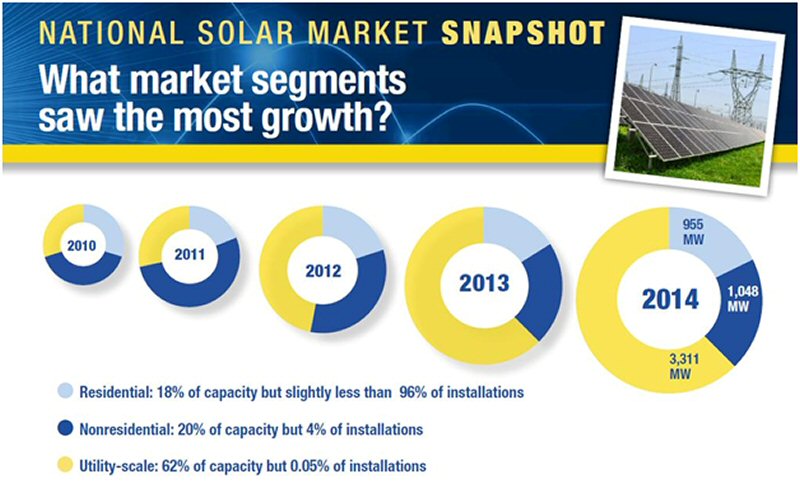
SEPAによると、2014年度に米国では18万20000件の新しい太陽光発電システムが設置され、その合計導入量は5.3GW(交流換算)に上るという。導入量が多い電力会社がある州は、カリフォルニア(CA)、ハワイ(HI)、アリゾナ(AZ)、ニュージャージー(NJ)、そしてノースカロライナ(NC)だった。
米国では、3000以上の電力事業者が、年間で約3兆7237億kWhの電気を、約1億3000万件の家庭と1850万件の商業・産業用の顧客に提供している。米国エネルギー省(DOE)のエネルギー情報課のデータによると、2014年の総電気販売金額は38億9000万米ドルであった。See More Here
Latest solar PV and other renewable energy market developments - policies, new products/services, business models, and market players - in the US and Japan
May 29, 2015
May 21, 2015
Panasonic Ramps Up Japanese Solar Manufacturing to Meet Domestic Rooftop Demand
Published at Renewable Energy World --- Panasonic Corp, a Japanese electronics company, announced that it will expand its domestic solar cell and module production to meet the rooftop solar demand in Japan. The company will invest a total of 9.5 billion yen (US$78 million) in a cell production plant in Shimane Prefecture and a module plant in Shiga Prefecture.
The company’s current HIT production capacity is 900 MW per year, of which 300 MW is produced in Malaysia and 600 MW in Japan. The new investment will boost the domestic production capacity 150 MW to total 750 MW by March 2016, making its total annual production capacity more than 1 GW.
Panasonic’s solar cells, known as HIT, are hetero-junction cells composed of monocrystalline and amorphous silicon. Panasonic reached a conversion efficiency of 25.6 percent last year at the research level, and 22.5 percent at the mass production level. Since high-efficiency cells enable more power per square foot than conventional solar cells, they provide a greater advantage to the majority of Japanese homes and offices, which have very limited roof-space.
The company will allocate the boosted domestic production capacity solely to the domestic market, specifically residential and rooftop systems below 500 kW while allocating modules produced in Malaysia to overseas markets.
Furthermore, as the domestic production ramps up, the company will phase out outsourced modules. The company has outsourced multicrystalline solar modules under an original equipment manufacturer (OEM) contract from Europe in order to meet demand for a large quantity of relatively inexpensive modules used for Mega Solar projects. In the fiscal year 2014, ending in March 2015, the outsourced solar modules represented approximately 18 percent of the company’s entire solar module sales, but the increased domestic production capacity will eventually replace all the outsourced modules... Read More Here
The company’s current HIT production capacity is 900 MW per year, of which 300 MW is produced in Malaysia and 600 MW in Japan. The new investment will boost the domestic production capacity 150 MW to total 750 MW by March 2016, making its total annual production capacity more than 1 GW.
Panasonic’s solar cells, known as HIT, are hetero-junction cells composed of monocrystalline and amorphous silicon. Panasonic reached a conversion efficiency of 25.6 percent last year at the research level, and 22.5 percent at the mass production level. Since high-efficiency cells enable more power per square foot than conventional solar cells, they provide a greater advantage to the majority of Japanese homes and offices, which have very limited roof-space.
The company will allocate the boosted domestic production capacity solely to the domestic market, specifically residential and rooftop systems below 500 kW while allocating modules produced in Malaysia to overseas markets.
Furthermore, as the domestic production ramps up, the company will phase out outsourced modules. The company has outsourced multicrystalline solar modules under an original equipment manufacturer (OEM) contract from Europe in order to meet demand for a large quantity of relatively inexpensive modules used for Mega Solar projects. In the fiscal year 2014, ending in March 2015, the outsourced solar modules represented approximately 18 percent of the company’s entire solar module sales, but the increased domestic production capacity will eventually replace all the outsourced modules... Read More Here
May 19, 2015
Born from Disaster: Japan Establishes First Microgrid Community
Published at Renewable Energy World --- Following the 2011 earthquake, tsunami and nuclear disaster in Japan, one city decided to transition to a clean, renewable future and became Japan's first microgrid community.
Although Japan's Fukushima prefecture is most commonly associated with the 2011 disaster due to the nuclear power melt-down, Miyazaki prefecture, located north of Fukushima, suffered the largest death toll, close to 10,000, and the largest flood damage in the nation.
Located on the coast, Higashimatsushima city was no exception. It had a catastrophic tsunami-caused flood, which put 65 percent of the city under water, with over 1,100 lives lost. Approximately 10,000 residents lost their homes and were forced to evacuate.
“After the disaster, some parts of the town didn’t get electricity for up to three months,” said Tohoru Ishigaki at the office of Future City Initiative under the city’s Department of Disaster Recovery Policy. “We strongly felt [after the disaster] that our responsibility was to provide reliable energy.”
Turn Local Tragedy Into a New and Vibrant Vision
To create a safe, resilient and sustainable society for the remaining population of 40,000, the city decided to deploy distributed, clean renewable energy sources. Under post-disaster recovery and reconstruction plans, the city set a bold goal to become a Net Zero Energy City by 2022, supplying the entire city with locally produced energy.
As a first step, the city turned a flood-affected former city park into a 2-MW solar photovoltaic (PV) project. This project symbolizes the city’s commitment to energy self-sufficiency. Mitsui & Co., Ltd, one of the largest trading company in Japan, completed this system in the summer 2013. The company also built PV carport systems with a total capacity of 270 kW at three locations on high ground, away from the vulnerable coastline. These sites are designated for evacuations and solar power will provide emergency power....Read More Here
Although Japan's Fukushima prefecture is most commonly associated with the 2011 disaster due to the nuclear power melt-down, Miyazaki prefecture, located north of Fukushima, suffered the largest death toll, close to 10,000, and the largest flood damage in the nation.
Located on the coast, Higashimatsushima city was no exception. It had a catastrophic tsunami-caused flood, which put 65 percent of the city under water, with over 1,100 lives lost. Approximately 10,000 residents lost their homes and were forced to evacuate.
“After the disaster, some parts of the town didn’t get electricity for up to three months,” said Tohoru Ishigaki at the office of Future City Initiative under the city’s Department of Disaster Recovery Policy. “We strongly felt [after the disaster] that our responsibility was to provide reliable energy.”
Turn Local Tragedy Into a New and Vibrant Vision
To create a safe, resilient and sustainable society for the remaining population of 40,000, the city decided to deploy distributed, clean renewable energy sources. Under post-disaster recovery and reconstruction plans, the city set a bold goal to become a Net Zero Energy City by 2022, supplying the entire city with locally produced energy.
As a first step, the city turned a flood-affected former city park into a 2-MW solar photovoltaic (PV) project. This project symbolizes the city’s commitment to energy self-sufficiency. Mitsui & Co., Ltd, one of the largest trading company in Japan, completed this system in the summer 2013. The company also built PV carport systems with a total capacity of 270 kW at three locations on high ground, away from the vulnerable coastline. These sites are designated for evacuations and solar power will provide emergency power....Read More Here
April 26, 2015
分散型太陽光の普及に赤信号、2016年にカリフォルニアで設置上限値に到達
Published at Nikkei Technology --- 前回の記事で紹介した「ネットメータリング」は、分散型太陽光発電システムによる“自産自消”を促すための制度である。太陽光発電による発電量で住宅などの電力消費量を相殺しながら、余剰発電量は次の月に繰り越して電気料金を削減する。この制度は、米国の分散型太陽光発電システムの普及に大きな役割を担ってきた(前回の記事)。
電力会社が余剰電力の購入価格を下げて、分散型太陽光発電システムの導入にブレーキをかけようとしていることを前回説明した。こうした電力会社の動きとは別に、早ければ2016年にも一部の地域でネットメータリングの見直しが始まる可能性がある。それには、分散型システムの導入を制限する「総設置容量上限」が関係する。
キャップを設置
州や電力会社のサービス管内で、法律や規制で定めた「キャップ(CAP)」と呼ばれる、ネットメータリングの総設置容量の上限がある。ネットメータリングを活用する分散型太陽光発電システムの総設置容量上限に達すると、電力会社は分散型太陽光発電システムの設置を基本的に拒否できるようになる。
ネットメータリング制度は、州の法律や州の公益事業委員会が定めたものである。各州で電力を販売する電力会社は、遵守する義務がある。州主導であるため、接続できるシステムの規模や余剰電力の取り扱い方、余剰電力の購入価格などが、州によって大きく異なる。もちろん、設置容量上限の値や、上限の決め方も州によって違う。州によっては、上限を州の再生可能エネルギー導入目標と同じにしている場合もある。
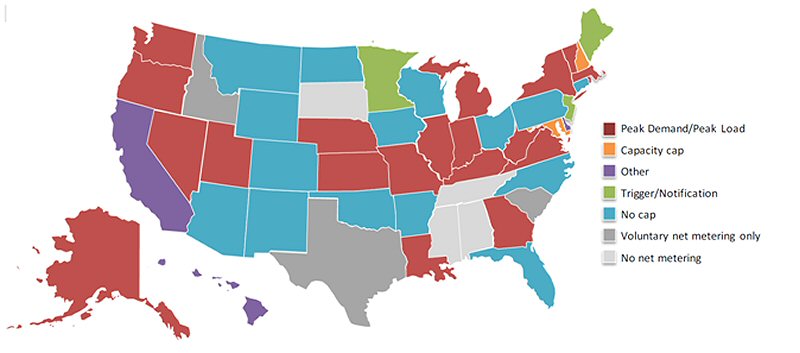
上限を定める基準として最も多く使われているのは、州または各電力会社の最大電力需要である。参照年と呼ばれる、特定の年の最大電力需要を上限の計算用に使う。ネットメータリング制度を施行しているのは、全米50州のうち43州とワシントンDCであり、この中の22州が最大電力需要を上限の基準に用いている。例えばユタ州は、2007年の最大電力需要の20%を総設置容量の上限としている。イリノイ州やミズリー州は、前年の最大電力需要の5%で上限を計算する。。。Read More Here
電力会社が余剰電力の購入価格を下げて、分散型太陽光発電システムの導入にブレーキをかけようとしていることを前回説明した。こうした電力会社の動きとは別に、早ければ2016年にも一部の地域でネットメータリングの見直しが始まる可能性がある。それには、分散型システムの導入を制限する「総設置容量上限」が関係する。
キャップを設置
州や電力会社のサービス管内で、法律や規制で定めた「キャップ(CAP)」と呼ばれる、ネットメータリングの総設置容量の上限がある。ネットメータリングを活用する分散型太陽光発電システムの総設置容量上限に達すると、電力会社は分散型太陽光発電システムの設置を基本的に拒否できるようになる。
| Net Metering Cap by State, Credit: National Renewable Energy Laboratory |
ネットメータリング制度は、州の法律や州の公益事業委員会が定めたものである。各州で電力を販売する電力会社は、遵守する義務がある。州主導であるため、接続できるシステムの規模や余剰電力の取り扱い方、余剰電力の購入価格などが、州によって大きく異なる。もちろん、設置容量上限の値や、上限の決め方も州によって違う。州によっては、上限を州の再生可能エネルギー導入目標と同じにしている場合もある。
上限を定める基準として最も多く使われているのは、州または各電力会社の最大電力需要である。参照年と呼ばれる、特定の年の最大電力需要を上限の計算用に使う。ネットメータリング制度を施行しているのは、全米50州のうち43州とワシントンDCであり、この中の22州が最大電力需要を上限の基準に用いている。例えばユタ州は、2007年の最大電力需要の20%を総設置容量の上限としている。イリノイ州やミズリー州は、前年の最大電力需要の5%で上限を計算する。。。Read More Here
Subscribe to:
Posts (Atom)