Showing posts with label wind. Show all posts

April 19, 2021

風力と太陽光で2035年に「1100 GW」、電力部門の脱炭素に現実味 米カーボンニュートラル戦略、変動性再エネと蓄電池を大量導入

 Published at Nikkei Technology - Mega Solar Business


CO2排出量は予測値から半減

 温暖化ガス削減を目指し「カーボンフリー」「カーボンニュートラル」という言葉が、企業、市町村などの地方自治体、州、そして連邦政府で頻繁に使われるようになった。実際、バイデン新米国大統領も、「2035年までに100%カーボンフリー・エネルギー」という野心的な目標を設定し、気候変動対策に乗り出している。

 そんな中、今月米エネルギー省(DOE)の研究所であるローレンス・バークレー国立研究所(LBNL)が、「ゼロまで道半ば:エネルギー(電力)部門のカーボンフリーへの進展」と題するレポートを発表した。

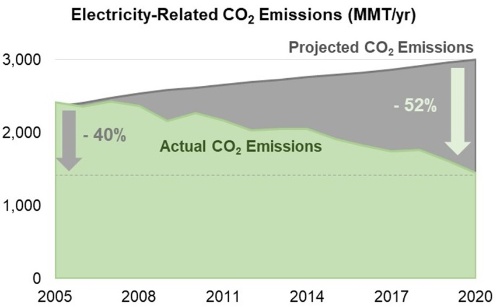
 タイトルから、「米国はカーボンフリーまでもう半分達成したのか?」と疑問に思い、同レポートの筆者でLBNLのシニア・サイエンティストを務めるライアン・ワイザー氏に質問してみると、「『ゼロまで道半ば』とは、2020年の(電力部門における)実際の温暖化ガス排出量が、以前に予測された2020年の排出量より52%少なかったことを意味する」との回答だった。

 ちなみにこの場合の予測値は、平常状態が惰性的に続く「なりゆき(Business As Usual=BAU)シナリオ」を採用している。

 米エネルギー省エネルギー情報局(EIA)が発表した「2005年(米国)年次エネルギー見通し」では、2020年の電力供給からの年間CO2排出量は、BAUシナリオで3008 MMT(百万メトリックトン)になると予測されていた。しかし、実際、2020年の電力部門からのCO2排出量は1450 MMTに留まり、ワイザー氏が言ったように、予測より52%、つまり半分に減った(図1)。...Read More Here

図1●電力部門での「BAUシナリオ」によるCO2排出量予測(グレー色面)と実際のCO2排出量(薄緑色面)
(出所:LBNL)


April 5, 2021

「原発」跡地に690MWのメガソーラー建設へ、蓄電池を併設 2050年までに太陽光は原子力を上回り主要電源に

 Published at Nikkei Technology - Mega Solar Business

 米アイオワ州にある、同州で唯一だった原子力発電所の跡地に出力690MWものメガソーラー(大規模太陽光発電所)開発プロジェクトが着々と進んでいる。

 米国中西部は「コーンベルト」と呼ばれ、トウモロコシが主要作物として盛んに生産されている。米西部に位置するアイオワ州は、その中心地であり、米国の燃料エタノール生産能力の4分の1を占める米国の主要なバイオエタノール生産地でもある。

 トウモロコシ由来のバイオエタノール、バイオディーゼルだけでなく、発電分野でも再生可能エネルギーの導入量が多い。実は、アイオワ州は、これまで米国でメガソーラーなどの大規模再エネ発電所の普及を牽引してきた「再生可能エネルギー・ポートフォリオ・基準(RPS)」制度の法案を全米で最初に成立させた州である。1983年のことだ。

 米エネルギー省・エネルギー情報局(EIA)によると、2019年のアイオワ州における総発電量のうち、5分の2以上は再エネで、そのほとんどが風力発電である。事実、同州はテキサス州とオクラホマ州に次ぐ米国で第3位の風力発電導入量を誇る(図1)。

図1●アイオワ州は米国の州別風力発電導入量で3番目
(出所:Iowa Farm Bureau)

太陽光では出遅れ

 しかし、太陽光発電の導入量では、大きく遅れている。米太陽光エネルギー協会(SEIA)によると、同州における2020年までの太陽光発電の累積導入量は、わずか287.8MWに過ぎない。米国における州別導入量での順位は35位に留まる。だが、2023年には太陽光の順位も飛躍するかもしれない。

 太陽光の躍進を予感させる話題の1つに、米ネクステラ・エナジーが、アイオワ州パロ郡の「デュアンアーノルド原子力発電所」跡地にメガソーラーを建設すると発表したことがある(図2)。...Read More Here

December 28, 2020

太陽光「過剰設備」と「出力抑制」で発電コスト削減!? 「暗黙のストレージ」で、蓄電池の容量を減らす

 Published Nikkei Technology - Mega Solar Business


「再エネ100%」実現戦略を分析

 「過剰な設置と出力抑制でクリーン電力100%を達成する」という、何ともショッキングなタイトルのウエビナー(WEB 上でのセミナー)が今月中に15日間、開催された。主催者は、クリーン・エネルギーを推進する非営利連合である米クリーン・エネルギー・ステイツ・アライアンス(CESA)である。

 電力会社では、必要以上の「過剰な発電所」は無駄な投資であり、太陽光を含む発電事業者にとって「出力抑制」は収入の減少を意味する。「過剰な設備と出力抑制」を推奨するようなセミナータイトルには、誰しも違和感を持つだろう。

 この発表は、電力需要を100%再生可能エネルギーで賄うための研究活動の一環になる。具体的には、クリーン・エネルギーに関するリサーチを行う米クリーン・パワー・リサーチ(Clean Power Research)が、米中西部の地域送電機関(RTO)であるミッドコンティネント独立システムオペレーター(MISO)のサービス地域全体で再エネ100%を模索する研究・調査分析の一部である。

 この分析の結果としてMISO地域において、太陽光と風力発電の「過剰な建設と出力抑制」が最も費用対効果の高い「再エネ100%」実現戦略であることを示した。 

 「再エネの拡大と迅速な送電」を効果的に実現することを目指し、発電設備のテクノロジーと最適な導入量、そして需給バランスを調整するテクノロジーを見出すため、シナリオ分析が行われた。クリーン・パワー・リサーチでリード・アナリストを務めるマーク・ペレズ氏がそれぞれのシナリオと分析結果を発表した。

なぜ「暗黙のストレージ」なのか?

 まず、(1) 発電設備のテクノロジーには、太陽光と風力発電、(2) 需給バランスを調整するテクノロジーには、リチウムイオン蓄電池などの電力貯蔵、そして「暗黙のストレージ(貯蔵)」との位置づけで「過剰な発電設備」とその「出力抑制」を考慮した。どうして「暗黙」と呼ぶのかという質問にペレズ氏は、「過剰な発電設備と出力抑制は、事実上、需給バランスを調整する機能を持っているから」と答えた。

 シナリオでは、太陽光と風力発電、さらに電力貯蔵のコストを大きく左右するテクノロジーの発展度合いを、2025年に「高いケース」「低いケース」、そして2050年に「高いケース」「低いケース」の4つのシナリオも加えた。...Read More Here


June 7, 2019

米太陽光市場、2030年までに「累積500GW」、SEIAが目標 国内総発電量で20%を占め、新たな基幹電源に

Published at Nikkei Technology ---

電力の太陽光比率は2.3%に

 米国エネルギー省(DOE)・エネルギー情報局(EIA)は、再生可能エネルギーが米国の総発電量に占める比率が2008年からの10年間で2倍に増えたと発表した。
 この急拡大は、風力と太陽光発電が大きく貢献していて、EIAのデータによると、太陽光の発電量は、2008年の200万MWhから2018年には9600万MWhに急増し、国内総発電量の2.3%を占めるまでに成長したという(図1)。
図1●米国における太陽光発電量の推移
(出所:U.S. Energy Information Administration)
[画像のクリックで拡大表示]

累積導入件数が200万件突破!

 さらに、先月、米国太陽光産業協会 (SEIA)は、 米国における太陽光発電設備の累計導入数が200万を超えたと発表し、米太陽光発電市場における「大きな節目」と位置づけている。
 これは、SEIAと、クリーンエネルギーに関する調査・コンサルティング会社であるウッドマッケンジー・パワー&リニューアブルの共同で制作されたデータによるもので、この200万件には住宅用太陽光発電システムだけではなく、商業・産業用、さらに数百MW規模の発電事業用太陽光発電所も含まれている。ちなみに200万件の太陽光発電設備の総出力容量は70GWを超え、これは、1200万軒に及ぶ米一般家庭の年間電力消費量に匹敵する(図2)。
図2●米太陽光発電設備導入数推移(四半期別・青、累積・赤)
(出所:Solar Energy Industries Association and Wood Mackenzie Power & Renewables)
[画像のクリックで拡大表示]
 SEIAによると、「最初の100万件」を達成するのに40年もかかったが、200万件に達する「次の100万件」は3年足らずで達成された。
 SEIAで最高経営責任者(CEO)兼社長を務めるアビゲイル・ホッパー氏は、「現在170億ドル規模のこの(太陽光発電)産業は、5年後にさらに2倍に成長すると予想されている。2020年代は、太陽光が新たな基幹電源に飛躍する10年間になると信じている」と語った。
 ウッドマッケンジー・パワー&リニューアブルは、米国における累積太陽光発電設備導入数は2021年には300万件、そして2023年には400万件を超え、今後も導入数が加速すると予想している。さらに、同社のアナリストによると、2010年には10分間毎に平均1件の太陽光発電システムが設置されていたものの、2024年までには、1分間に平均1システムの設置ペースとなると予想されている...Read More Here

October 18, 2016

The Asia Super Grid – Four Countries Join Together to Maximize Renewable Energy

Published at RenewableEnergyWorld.com --- The triple-disaster of earthquake, tsunami and nuclear meltdown that hit the northeast of Japan in March 2011 was a wake-up call for many people. This was true for Masayoshi Son, a founder, chairman, and chief executive officer (CEO) of Softbank Group, a Japanese multinational telecommunications and internet corporation. Having experienced the danger of nuclear power plants in Fukushima, he felt the need to replace nuclear power with safer and cleaner renewable energy for a better future.

To accelerate the deployment of clean, safe, and affordable renewable energy, he founded the Renewable Energy Institute (REI), and in September 2011, the “Asia Super Grid (ASG)” was conceptualized. ASG goes beyond Japan and includes other Asia countries to further maximize the usage of renewable energy by taking advantage of diversity in loads and resources.

At an International Symposium this September to celebrate REI’s five-year Anniversary, Son happily announced that his “Vision of the ASG” was one step closer to materialization.

“When I announced my idea five years ago, many people said it is a crazy idea, and they also said that it is neither economically or politically feasible,” recalled Son. Despite these nay-sayers, he has been making steady progress.

The first step was to develop electricity generation plants domestically by creating SB Energy Corp. as part of the SoftBank Group in 2011. The company is now established and operating 33 utility-scaled renewable power plants nationwide, including a 48-MW wind farm in Shimane prefecture and a 111-MW solar PV farm in Hokkaido prefecture.

The company also looked outside Japan for more abundant renewable energy sources. Mongolia has vast wind resources, and to harness the potential, the company formed Clean Energy Asia LLC with Newcom LLC, a Mongolian conglomerate. The joint company has secured a land-leasing right in the Gobi Desert for the next 100 years to develop and operate 7 GW worth of wind farms. The company also formed a joint venture company called SBG Cleantech Ltd in India, with India’s Bharti Enterprises Pvt. and Taiwan’s Foxconn Technology Group, to develop a 350 MW solar PV farm in the southern state of Andhra Pradesh.

MOU Signed by Japan, China, South Korea, and Russia

Plenty of renewable energy generation has been secured and is under development. Now the question is how to move the renewable energy to Japan and throughout Asia....Read More Here
Representatives from Japan, South Korea, China, and Russia sign MOU in Beijing.
Image credit: SoftBank Group

November 24, 2015

Japan Passes FIT Peak: Now What for 87 GW Renewable Queue, 2030 Energy Mix?

Published at RenewableEnergyWorld.com --- Between July 2013 and July 2015, the Japanese feed-in tariff (FIT) program has supported the installation of over 22 GW worth of renewable energy nationwide, according to the latest data released by the Ministry of Economy, Industry and Trade (METI). That means, in only three years, the nation doubled its renewable energy capacity. Those renewable energy projects have cumulatively generated 66,854 GWh of renewable electricity, roughly equivalent to the annual electricity consumption of the state of Minnesota, ranked 19th in the U.S. for clean power generation.

Source: Japan METI
The FIT program heavily skewed toward solar

Although the program supports five renewable technologies: solar photovoltaic (PV), wind, hydro (below 30 MW), geothermal and biomass, PV accounts for 96 percent of the 22 GW of installed capacity in the last 37 months.

Source: Japan METI


The FIT program aided Japan in its ascent towards becoming one of the world’s biggest PV markets in 2013 and 2014. According to METI’s data, Japan installed 8.51 GW of PV under the FIT program. In the first seven months of this year, Japan has already installed a little over 6 GW. If Japan manages to install 1 GW of PV every month from August to December of this year, Japan will hit, as many PV industry analysts have predicted, 10 GW and solidify its position at the top of the list again this year....Read More Here

November 11, 2015

Japan’s Local Energy Providers Turn to Distributed Generation

Published at Renewable Energy World --- Let the games begin! By fully deregulating its electricity sector by next April, Japan plans to break up the 60-years of regional monopolies controlled by 10 vertically-integrated, investor-owned utilities (IOUs). Just at the end of October, 778 companies registered as power producers and suppliers (PPS) in order to sell electricity for commercial consumers who have a demand over 50 kW. In addition, 48 companies have registered and been approved as retail electricity providers to sell electricity to residential and small business customers.

The Great East Japan Earthquake and Tsunami Disaster of March 2011 marked a pivotal turning point in the conception of the nation’s electricity infrastructure. Specifically, safety and reliable supply. Due to the temporary shut-down of the country’s nuclear power reactors, some areas of Japan experienced rolling blackouts as well as large electricity rate hikes due to the resulting supply constraint.

The deregulation in process is expected to stimulate competition as well as lower the cost of electricity. According to a national survey taken by Mizuho Information & Research Institute, Inc., 83 percent of respondents said that they would switch providers if prices decrease.

Regarding energy mixes, 36 percent of respondents said that they would switch to renewable electricity providers as long as prices remain similar to what they are now, while and 5 percent said that they would use renewable energy only if prices decreased. Separately, 32 percent of respondents said that they do not want to use electricity generated by nuclear power plants.

Solar PV Installed on a Distribution Warehouse, Credit: Seikatsu Club Energy


Return of Nuclear Power for Deregulation?

Although the nation is still working to clean up after the 2011 Fukushima No. 1 nuclear power incident, the Federal of Electric Power Companies of Japan (FEPC) claims that nuclear power is important for the nation’s energy independency and energy affordability. In fact, the incumbent utilities have gradually restarted some of the nuclear power plants, which were taken offline after the Fukushima disaster....Read More Here

September 30, 2015

Japan: Goto City Aims to Become ‘Islands of Energy’ by Harnessing Offshore Wind

Published at Renewable Energy World --- Off the coast of Kagoshima island, a part of Goto City in Kagoshima prefecture, Japan’s first on-gird 2 MW floating offshore wind turbine (FOWT) is about to complete its mission as a demonstration project.


Goto City is now planning to take the demonstration FOWT project to the next level by deploying over 500 MW worth of offshore wind power.

Goto City is located in the westernmost Kyushu region, which is the south-westernmost part of Japan’s main islands. The city consists of 11 inhabited islands and 52 uninhabited islands across the East China Sea, with a total population of about 40,000. The city is blessed with natural resources and has an oceanic climate, featuring warm summers and cool winters.

The city has developed an extensive renewable energy plan, with a mission of “Islands of Energy – Energizing the town by producing energy.” By maximizing its natural resources, it is planning to cover 132.4 percent of its total energy needs (oil, gas and electricity) with renewable energy by 2030.

“With the population decline and aging, we fear to become a disappearing community,” Kazuyuki Kitagawa, a spokesperson for the Goto City Renewable Energy Promotion Department, said.
“Exceeding our energy self-sufficiency level is not our ultimate goal. It is one of the solutions to stimulate our local economy by creating local employment and industry for years to come. We are aiming at locally producing and exporting renewable energy.”

In 2012, renewable energy provided 4.4 percent of the city’s total energy consumption, producing 97,189 gigajoules (Gj) per year, the equivalent of 27 GWh per year. Of 27 GWh, 88.5 percent was provided mostly by onshore wind power... Read More Here